
Founder Vesting: The Conversation Every Startup Needs to Have
Guest author: Carter Chojnacki, Associate Attorney at Michael Best
What happens when a co-founder or key employee leaves? How does that departure affect the cap table? Few founders have concrete answers, and that uncertainty represents a significant, often hidden, risk. While many founders correctly assume that issuing equity incentivizes and aligns co-founders and service providers with the company’s goals, fully vested shares may actually defeat that alignment and present a material risk. A vesting schedule is the solution. Vesting protects both the company and remaining founders when departures occur. Nearly all well-run startups implement vesting from day one, and strategic founders use vesting to motivate the future workforce. When founders understand and implement vesting early, they remove a lot of headaches down the road.
What is Vesting in Simple Terms?
Vesting is the process by which founders and employees earn their equity over time. Until shares vest, the company can take them back if the holder leaves. Vesting ties ownership to continued contribution, so equity rewards the people who stay and build the company.
Why Vesting Matters: Preventing Dead Equity
Early-stage equity grants attract talent, align incentives, and create an ownership culture. However, equity without vesting is a liability. Consider this example: A co-founder who walks away six months in and keeps a full ownership stake leaves the company with 'dead equity', meaning shares held by someone who no longer contributes.
How Founder Vesting Works: Reverse Vesting
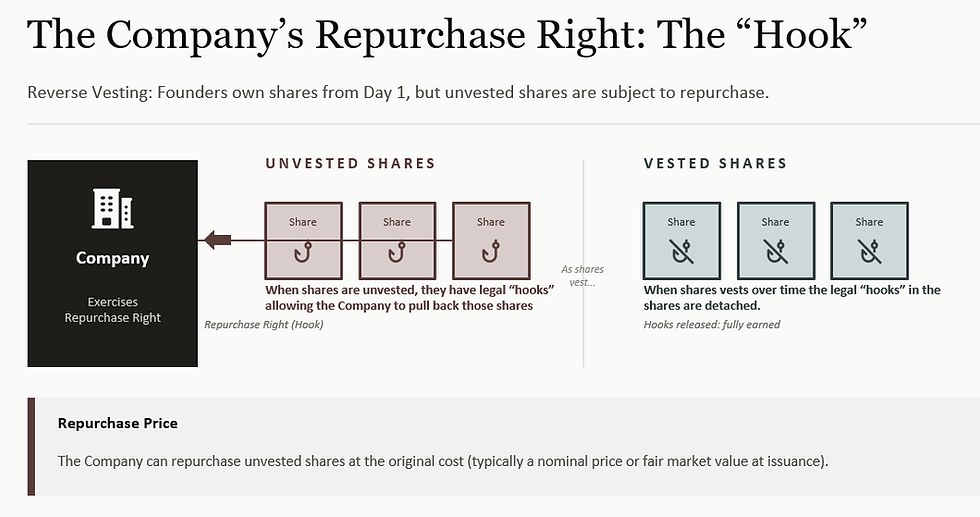
With vesting, founders typically receive all of their stock on Day 1. They legally own the shares and can vote them immediately. However, the company retains a repurchase right on the unvested portion. If a founder departs before fully vesting, the company can buy back unvested shares at a nominal price (often the original purchase price). Think of the company as holding a legal “hook” on the shares, allowing the company to pull them back if the founder leaves early. As shares vest, the repurchase right lapses and they become “unhooked.” This structure is known as “reverse vesting.” Reverse vesting gives founders immediate ownership while protecting the company from premature departures.
The Standard Vesting Schedule: 4 Years with a 1-Year Cliff
The market-standard vesting schedule is four years with a one-year cliff, followed by monthly vesting. Under the market-standard approach, no shares vest during the first year. If a founder remains through the one-year anniversary, 25% of the total grant vests at once. This first vesting event is the “cliff.” After that, 1/48th of the total shares vests each month until the grant is fully vested at year four. The cliff effectively serves as a trial period, and anyone who leaves during the first year retains no shares, which prevents any “dead equity” accumulation.

Should a Solo Founder Be Subject to Vesting?
Founders who have operated solo since incorporation sometimes wonder whether vesting applies to them. After all, if there are no co-founders who might leave, what is the point? The answer is that vesting serves purposes beyond protecting against early departures. Vesting positions the company and founder for future growth.
First, implementing a vesting schedule, particularly the market-standard four-year schedule, establishes credibility when asking future service providers to accept vesting on their own equity. Employees, advisors, and consultants are far more likely to view their vesting terms as fair when the founder is subject to the same structure. This eliminates claims of unfairness and fosters a culture of shared commitment.
Second, when bringing on key executives, the founder can point to the fact that all equity holders, including the founder, are subject to the same vesting schedule. This reinforces fairness and signals to senior hires that the founder is equally committed for the long term. Key executives often negotiate equity terms carefully, and demonstrating that the founder has skin in the game on the same terms can be a meaningful recruiting advantage.
Third, proactively implementing vesting eliminates friction with future venture capital investors. VCs will almost always require founder vesting as a condition of investment. A founder who has already implemented vesting demonstrates good governance and alignment with market expectations, removing a potential negotiation point and speeding the path to closing. Rather than treating vesting as a concession during fundraising, a sole founder who implements it early reframes the conversation as one of preparedness.
Customizable Vesting: Time-Based vs. Milestone-Based
Time-based vesting is simpler to draft and administer. Milestone-based vesting can be appropriate where value is tied to specific objectives, such as hitting a revenue target, launching a product, or closing a financing round. Companies implementing milestone vesting should follow the SMART framework often used for setting personal goals: Specific, Measurable, Achievable, Relevant, and Time-bound.
Vesting for Stock Options
Vesting applies to stock options as well as restricted stock. Options are the more common form of equity compensation for employees who join after the earliest stage. The same four-year, one-year cliff structure typically applies. Incentive stock options (ISOs) offer favorable tax treatment and are available only to employees. Non-qualified stock options (NSOs) are used when ISO requirements cannot be met.
Acceleration: Single Trigger vs. Double Trigger
What happens to unvested shares when a company is acquired? The answer depends on whether the vesting schedule includes an acceleration provision. The two common approaches are single-trigger and double-trigger acceleration.
Single-trigger acceleration vests all unvested shares immediately upon acquisition. The employee owns the shares outright when the deal closes. While this sounds generous, single-trigger acceleration removes a key incentive for the employee to stay and support the transition.
Double-trigger acceleration requires two events: a change-of-control transaction and the employee’s termination (either before closing or within a defined period afterward, often twelve months). VCs prefer this structure because key employees remain incentivized to support the acquisition and assist the acquirer during the transition.
Board members and advisors are an exception. Because they often do not participate in post-closing transitions the same way employees do, single-trigger acceleration is more common for these roles.
Investor Expectations: Revesting as a Point of Renegotiation
Investors almost always require vesting as a condition of financing. In many cases, investors with significant leverage will require founders to re-subject their shares to a new four-year vesting schedule with a one-year cliff, even when the founder has already vested a substantial portion under an existing schedule. For example, a founder three years into a four-year vesting schedule may be asked to restart vesting entirely. This practice, known as “revesting,” is a negotiation point that arises during financing rounds.
One nuanced practice point is that investors are generally less likely to raise the issue of revesting when some form of vesting is already in place. Conversely, if a founder’s shares are entirely unvested at financing, investors are more likely to insist on implementing a vesting schedule. The practical implication for founders is having vesting in place before a financing round can optically improve the founder’s negotiating position by potentially taking the “revesting” topic off the table.
The War For Top Talent is Real And is Coming For Your Key Employees
Vesting does more than guard against underperformance. High-flying AI companies like Anthropic, OpenAI, SpaceX, Microsoft, and Meta are poaching top entrepreneurial talent with exceptionally generous compensation packages. Competition for engineers and technical leaders has never been fiercer, and employee and founder mobility remains high. Vesting accounts for the full spectrum of departure scenarios. A co-founder might leave because they are not contributing, because of a personal disagreement, or because a competitor made an irresistible offer. Vesting protects the company regardless of the reason.
Vesting Documents and the 83(b) Election Deadline
A Restricted Stock Purchase Agreement typically sets forth vesting terms for founders. The board of directors will pass an approval resolution specifying the vesting schedule, grant date, and other key terms. Keeping these documents in order from the outset avoids scrambling during a future financing or exit. For the companion agreement that protects your company’s IP, see CIIAA for Founders.
Founders who receive restricted stock subject to vesting must file a Section 83(b) election with the IRS within thirty days of the stock grant. This election allows the founder to pay taxes on the stock’s value at grant, when the value is likely minimal. Without this election, the founder would pay taxes at vesting, when the value may be significantly higher. The thirty-day deadline cannot be extended or waived. Missing the deadline can cause severe tax consequences. The IRS has launched an online e-filing system using Form 15620. My preferred practice is to jump on a call with the client and walk them through the online e-file program right after they sign their Restricted Stock Purchase Agreement, to ensure the form is properly filled out and to confirm the election was filed.
When to Call a Lawyer
The best time to put vesting in place is at company formation. Founders should establish vesting before onboarding co-founders and early team members. An attorney can help structure vesting schedules, draft the right agreements, and ensure compliance with tax and securities laws.
The views expressed in this post are those of Carter Chojnacki and Beth Ott as individuals and are not meant to represent the views of their respective organizations, Michael Best & Friedrich LLP and StartingBlock Inc. Nothing in this blog post should be construed as specific legal advice. Please consult an attorney for advice specific to your situation.


